
Imagine waking up every day feeling like a dark cloud won’t lift, depression, anxiety, or stress weighing you down, making work, family, and fun feel impossible. You’re not alone; millions face this in the USA. But what if you could get powerful help without checking into a hospital or quitting your life?
Enroll in an Intensive Outpatient Program (IOP) for mental health, an intervention that condenses hourly mental health treatment into your timetable. No weekend retreats, only three-hour classes once or twice a week where professionals instruct actual skills to counteract such problems as depression or PTSD. It is adaptable, efficient, and allows practicing coping at home immediately. Ready to reclaim your days? This guide has it all; how IOP outpatient works, as well as the reasons why it is changing lives all over the country. Hang around, you may get a push-up you want!
What Is an Intensive Outpatient Program?
An Intensive Outpatient Program or IOP is a program of organized mental health care that you receive several hours a day, several days a week, at home. It also allows you to continue with your job, family, and household chores, as compared to an inpatient stay, where you are forced to stop everything.
This Intensive outpatient program for mental health is centered on group therapy, individual counseling, and skill building. It is ideal with adults whose symptoms are not severe enough to require full-time care, but who do require more than an hour-a-day schedule of therapy. Consider it as your path to a healthy life.
The programs are commonly operated 9 to 19 hours per week, divided into 3-hour shifts, usually in the evenings or mornings to accommodate the work schedules. In the USA, such mental/behavioral health outpatient services are provided at places such as community mental health centers, hospitals, or private clinics.
Why Choose an IOP for Mental Health?
You may choose an IOP when such mental health issues as depression or anxiety have been affecting your daily life, yet the essentials are safe. It is between partial hospitalization and a step up from solo therapy sessions.
The Adult psychiatric intensive outpatient programs are doing well in the transition of inpatients or even bypassing inpatient care. Why? They tackle root causes with intensive support, reducing relapse risks while you practice real-world coping.
IOPs are insurable conditions, including depression, schizophrenia, or mental health-related substance use. It is also cheap and does not incur hospital expenses, and results are achieved. Great progress is witnessed in weeks by many.
Intensive Outpatient Psychiatric Program Explained
We shall deconstruct the actual functioning of an intensive outpatient psychiatric program. Imagine the following: You attend a clinic three or five days per week to attend therapy, education, and peer support sessions. You do not need to grab a bag and stop your life.
Daily Structure and Sessions
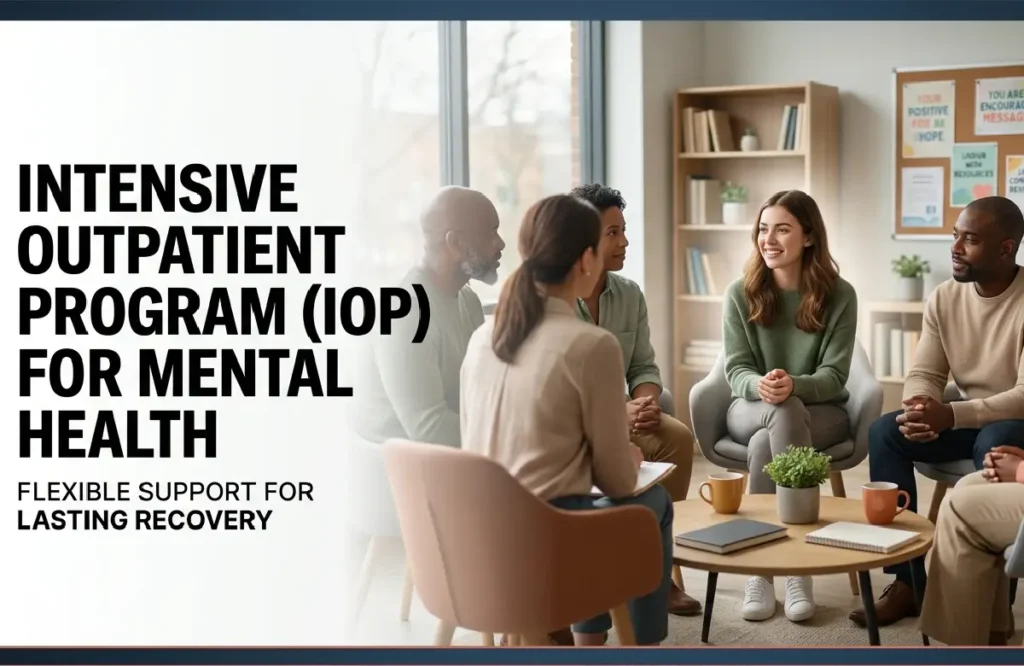
An average day begins with a check-in group in which everybody talks about wins and struggles. This causes the community to grow quickly, because their understanding of others creates less isolation. Secondly, there is core therapy, such as cognitive behavioral therapy (CBT), to rewrite negative thoughts.
The personal issues are probed during individual sessions, including what outpatient therapy is for depression. Your counselor designs strategies, perhaps including drug prescription. Afternoons focus on skills workshops: Mindfulness for anxiety, stress tools for work life.
Evenings? You are home practicing what you have learned. The programs are 4-12 weeks long, and the homework includes journaling of feelings or trigger tracking. Progress checks modify the plan so that it suits your requirements.
Who It’s For: Real-Life Examples
IOP applies to moderate problems of adults 18+. Consider Sarah, a mother with postpartum depression. Outpatient mental health services through IOP made her able to handle her moods and avoid leaving her kids. She went out at night, learned breathing programs, and restored confidence.
Or Mike, a vet with PTSD. His IOP outpatient program helped him to get back to work after his inpatient stay. Group discussions made his experiences acceptable; family meetings restored family relationships. He left a better graduate, armed with hard times.
In the case of dual diagnosis, such as depression and addiction, elements of intensive outpatient psychiatric programs, such as relapse prevention, are used. The sessions educate management on good habits and networks. It is comprehensive, striking the mind, body, and relationships.
How Sessions Build Lasting Change
How is mental health when it is outpatient? Using evidence-based practices. Dialectical behavior therapy (DBT) involves emotion control, and motivational interviewing enhances adherence. The educational groups include brain science and busting myths.
Family involvement is key. Family members come together to be taught limits and communication, which is essential in the long-term recovery. Online IOP products appeared after the pandemic, and they became accessible in rural USA locations.
Measures of success: 70-80% of those who complete the program claim that they experience symptom decreases, according to studies. It is flexible; there exist programs with trauma-oriented courses or women/men groups. Staff? Quality assurance is guaranteed by licensed therapists, psychiatrists, and counselors.
Fitting Into Your Life
IOP, unlike residential, holds your world in high regard. Attend afternoons, mornings of work? Done. School? Many student tracks exist. The prices range between $5000 and$15 000 on average, frequently paid by insurance (see Medicare/ACA plans).
Challenges? There is a case of a drop in transport or motivation. Peer buddy, ride share programs go against each other. Virtual hybrids combine face-to-face intensity with the comfort of the home. It is empowering; you are in charge of speed, and the professionals lead you.
Key Benefits of IOP Outpatient Care
There are increased benefits of jumping into an IOP on top of basic therapy. First, one is flexibility rules, as you live at home, avoiding inpatient isolation.
- Routines: Jobs, school, family intact, training in the real world.
- Cost savings: Lower than hospitals; most of it is covered by Medicare/insurance.
- Peer support: Groups help to feel at home, and loneliness is chopped in no time.
- Whole body development: Therapy, drugs, life skills, and comprehensive medical care.
Relief of the symptoms occurs fast: Improved sleep, mood stability, and reduced crises. Long-term? Reduction in readmission rates, increased resilience.
Tips for Thriving in Your IOP
It is easy to maximise your outpatient services with respect to mental/behavioural health through the following strategies.
- Prep mentally: Journal goals pre-start; devote yourself to each session.
- Build habits: Have homework in combination with a daily walk or call to sponsors.
- Communicate: Instruct your therapist when something is off-plan or changes.
- Ease yourself into groups: Be an open sharer; these relationships last after the program.
- Self-care tips: Sleep, eat, drink less- cuts like white elephants.
- Track wins: Note small changes weekly; celebrate them.
The alumni groups maintain momentum after IOP. These guidelines make good programs life-changers.
Conclusion:
In wrapping up, an Intensive Outpatient Program (IOP) for mental health gives you intensive support without pausing life, perfect for tackling depression, anxiety, and more through outpatient mental health care. It’s flexible, effective, and fits USA realities with insurance backing.
Ready to take the next step? Visit Minds Over Matter to find local IOP options and start feeling better today.
FAQs
How does IOP outpatient differ from regular therapy?
IOP outpatient packs in more hours, often 9-20 weekly, with group support and skill-building. Regular therapy is just 1-2 solo sessions. It’s ideal for moderate needs needing extra structure.
What is an Intensive Outpatient Program for Mental Health?
An Intensive Outpatient Program (IOP) for mental health is structured outpatient care. It offers 9+ hours of weekly therapy for issues like depression or anxiety. You attend sessions but live at home, not in a facility.
Who qualifies for an adult psychiatric intensive outpatient program?
Adults 18+ with acute but manageable symptoms qualify for adult psychiatric IOP. Think anxiety, depression, or PTSD, not needing a 24/7 hospital watch. A doctor assesses to confirm fit.
What is outpatient therapy for depression like in IOP?
Outpatient therapy for depression in IOP uses group and individual CBT sessions. You learn to challenge negative thoughts and build daily mood skills like mindfulness. It’s hands-on and supportive.
How does outpatient mental health work daily?
Outpatient mental health in IOP means 3-hour sessions, 3-5 days a week. They mix therapy, education, check-ins, and skills practice. You head home to apply what you learned.
Are intensive outpatient psychiatric programs covered by insurance?
Yes, intensive outpatient psychiatric programs are often covered by Medicare, Medicaid, and most private plans as mental/behavioral health outpatient services. Check your policy for details and copays.
Can I work while in IOP?
Absolutely, you can work during IOP. Schedules flex around jobs, often evenings or mornings. This lets you practice skills in real life while getting intensive support.